Grade of a coin


I see a lot of posts where people ask, how much is a 1911 Pig Rupee or how much is a 1936 1/4 Anna. But rarely do I hear someone qualifying the coin in terms of grade. Depending on the grade of the coin the coin can be worth anywhere between the price of silver to a 10's and thousands of rupees. Grade is such an important thing! So I want to take a few minutes to let everyone know my thoughts about grade.

What is Grade?
Depending on how unchanged and unscratched and uncleaned the coin has been since the time it has been minted, the coin is given a grade. There are different ways in which grades are measured. The most famous one is the Sheldon scale. It is a number from 1-70. Where 1 is barely identifiable to 70 which is a perfect coin. The probability of a coin just minted by the mint being graded 70 is one in a few thousand coins. For more information about Sheldon's grading see here.
www.coins.about.com/od/coingrading/f/sheldon_scale.htm
www.en.wikipedia.org/wiki/Coin_grading#The_Sheldon_rarity_scale


How can I tell what grade my coins is?
It requires a lot of practice and experience but a good place to start is getting an idea how a coin in each grade will look like. Here is a link about all US coins and pictures of each coin in every grade. This will give you an idea about how each grade looks like. I use this article as a baseline for grading my coins.


Remember that a shiny coin is not always a higher grade, look for scratches and evidence of cleaning. Get a magnifying glass and notice the surface of the coin. It should not have scratches from cleaning whic is different from scratches from clashing with other coins(this is called bagmarks). See how the dust is spread across the coin. See if there is something unnatural about the coin.


Coin should never never never be cleaned. The moment it gets cleaned or even touched, the surface starts reacting with your bodily oils and starts getting destroyed. Always use a cotton glove to handle coins if you want to maintain the pristine state of the coin. Do not store the coin in any plastic cover because the plastic contains PVC that could damage the coin and make it go bad in a few years. Do not put it in water or use a toothbrush to clean it or tamarind or anything else.
BRITISH INDIA - HALF RUPEE - GEORGE V - SILVER


United Arab Emirates ( UAE ) | Coins

The dirham (Arabic: درهم‎) (sign: د.إ; code: AED) is the currency of the United Arab Emirates. The ISO 4217 code (currency abbreviation) for the United Arab Emirates dirham is AED. Unofficial abbreviations include DH or Dhs. The dirham is subdivided into 100 fils (فلس).


Below coins are part of my collection :

25 Fils
50 Fils
1 Dirham
1 Dirham (Magnetic)


1 DIRHAM COINS


50 FILS COINS


25 FILS COINS


Withdrawal of all old series of Banknotes issued prior to 2005

This is share information about RBI's Notice regarding abolishment of all the banknotes issued prior to 2005 from March 31st 2014.

Please make sure that you don't keep any old notes stocked at home. They will be worth nothing later.

If anyone wants to dispose of any old notes bundle or notes in good condition, they can contact us. We might take some for collection purpose..  Click here to contact us.

Link : http://www.rbi.org.in/scripts/NotificationUser.aspx?Id=8715&Mode=0

What are Milled Edge Coin variants actually.... ??

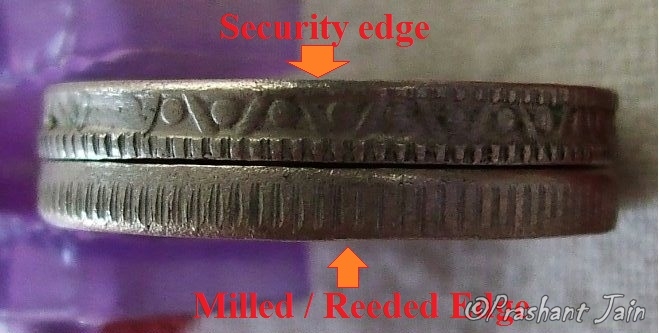
Security Edge ?? Milled Edge ??

Most of the coin collecter have a doubt regarding milled/reeded edge variants for security edge high value coins... Are these deliberately minted ? If yes then how come a coin has partial milled edge and partial security edge ?? Or are these coins some sort of error coins ? And if error why are they listed as variants in Krause Catalog as varaints.... ??

Here is a article which might help u gets your doubt clarified :

Normally high value coins are produced with a 'Security edge' like Rs.2 coins in before 1990s and Rs.5(normal and commemorative) coins till 2008. This is done to check counterfeiting(making fake coins) of coins. Coins having 'security edge' are first struck with the usual upright milling at the time the obverse and reverse designs are impressed upon them same as the edge of milled coins shown in this article . These are next passed through a second press, where the security mark is put on the edge, under pressure.

But, while being fed into the second machine, if a few coins accidentally skip the press, these may go to circulation with normal upright milled edge or if get pressed partially they lead to partial security edge and rest milled. 
Thus we find another type of error in coin specimens with upright milling which should have a 'security edge'.
These are milled edge or partial security edge variants of such coins.

Then the question comes why these are not categorized as error 
coins even when they are actually error coins. The only reason for this is that the number of such error coins having milled edge is large as compared to any other kind of error coins which makes them a variant rather than a error coin.

History of Security Edge... how the term was coined ??

In olden days the coin was fed manually and the impression was hammered.The coins was made of silver and unprincipled persons used to shave the coin near the edges to steal part of the silver. Hence when automatic machine minting came in to use, A security edge was implemented around the circumference thereby proving that the coin had not been tampered with and the weight of the coin remained the same as per the minted coin. Hence this impression around the edges was called security there by securing the actual weight of the coin.


 Some pics of the such variant coins :


Special thanks to senoir coin collecters Sekhar Kausik and Balakrushna Kar who helped me in writing this article.

Note : Not all Milled edge coins are error coins. Recent rs.5 Ni-Br coins 2009 onwards and olden days silver coins had milled edges only.

Most sought after Numismatic Books for Free Download

Here a link for the most sought after Numismatic materials , Krause Publication Catalogs and other numismatic literature , software , etc... available for free download :


For other books and softwares : 

>>> CLICK HERE <<<


If you find this post useful kindly put likes and comments :) 
Join my blog to get updates related to coin collection. :)


Disclaimer : Link provided above are external and i'm not responsible for the contents of the link.
Note:This is not for promoting piracy. Its just to share the link i got . i'm no way responsible for its content.

20 Paise Al-Mg Commemorative coin KM#45 KM#46

There were two different 20 Paise Aluminium-Magnesium Alloy Commemorative coins issued.

Details as per standard catalog :

Hyderabad Mint :  FAO Reverse Side   -------------------  a variant of same mint coin : some sort of error coin
Observe of the same coin : 

Hyderabad Mint Fishries Coin  Reverse Side -------------------Kolkata Mint Fishries Coin Reverse Side 
Observe of the same coin :

Coin Collection

" Coin collecting is the only hobby in the world that you can spend all the money in the world and still have some left over. "


Dear Friend, Thank you for visiting my blog. I have been collecting coins and bank notes of India and other countries from my child hood days.... which gained momentum after 2005.. At that time, I had no internet access , what to speak of internet, even no reference books on coin collection were available with me. I simply collected coins from circulation, choosing only by different designs and photos, then I started collecting for different years and then different mints...then different countries....

I gained a good knowledge about the science of coin collection after I browsed through Internet about coins and some idea from my uncle.

As I am a engineer by profession, I wished to share my knowledge about coins with my fellow collectors and I presume that I have achieved my aim to some extent by starting this blog. I have tried to post the facts and figures needed by collectors of coins. You, as a guest to this blog, are the right person to impartially judge about how far I am successful in my mission.

Your creative suggestions, criticism are cordially invited for the improvement of the matter furnished in this blog. To err is human. If you find any errors any where, please feel free to point out those errors, so that those would be removed as early as possible.

Comments welcomed :)

Half Anna Coins of George VI


Latest Coin Booking Advertisement

Rabindra Nath Coins available for rebooking from 16/8/2011 to 20/09/2011


Click on the Image above to see the zoomed view of the advertisement.

1 Naya Paisa Bronze and Nickel-Brass Coins : KM # 8 , 8a , 9 , 9a

 
Details as per standard catalogs :

Reverse Part of coins of different Years and Mints : 


Observe Part of Coin : 
Ashoka Lion Pedestal


My Collection of 20 Paise - Aluminium Magnesium Hexagonal Coin - KM # 44

Detail as per standard catalog :

Note : These coins were made of Aluminium Magnesium Alloy wrongly mentioned as Aluminium in standard catalogs.Refer Kolkatta mint link for more details : Click Here


Diamond below the year on reverse face of coin represent Mumbai Mint coin , star represent Hyderabad mint coin and no mark represent Kolkata mint coin.
Reverse Part of Coins :


Observe face of the coin :


Most rare of such coins is 1997 Hyderabad Mint coin which cost $10 as per standard catalog.


Click on any image above to have a look at zoomed high clarity image.